Introduction
I have many past and present students, as well as family and friends, who have been asking me what is going on in Oklahoma. What is fracking? Why is fracking causing earthquakes? Why are there earthquakes in Oklahoma?
The biggest question is how the fracking process is causing large quakes. So, I am providing a few links that will clarify what the fracking process is and also about the disposal process for the wastewater generated from the fracking process.
The entire process of fracking, from well production to wastewater disposal, has not historically generated macro seismic events (significant earthquakes 5.0 and over). It is important to realize that the hazards from the process of fracking a shale unit and disposal of fluids used in the process are not usually “seismic” but instead involve the potential contamination of groundwater if the process is not regulated properly.
What is Fracking?
Here are some excellent video links that will help you understand the process in 3 dimensions. Understand that we have been using the fracking process for about 60 years now, and the process, in and of itself, is not bad. The following bullet points and discussion may help you better understand the issue.
Ideal Fracking Process: Marathon Oil https://youtu.be/VY34PQUiwOQ
Disposal Process of Fluids used in Fracking Process: Ideal Disposal Process: Cypress Energy https://cypressenergy.com/our-industries/water-and-environmental-services/
The process used for 60 years – the uptick in recent use since geopolitical struggles in the Middle East have led to a push for greater domestic production. The process is relatively safe if regulations are followed.
What are the dangers?
- Micro seismicity
- Re-activation of pre-existing faults
- Potential increase in local seismic activity
- Community overprinting during the well completion process – large trucks, dust, noise, seismicity
- Contamination of groundwater
Who regulates the process?
Regulations: https://www.epa.gov/hydraulicfracturing
Assessment of the Potential Impacts of Hydraulic Fracturing for Oil and Gas on Drinking Water Resources
United States Environmental Protection Agency: SAB Review
What is causing the increase in earthquakes over 5.0 in Oklahoma?
The geologic history of the region is dynamic, and there are more variables at play than just human overprinting. In this case, overprinting means when one feature overlaps, adds to, or somehow changes the original. The effects caused directly or indirectly by human activity, are added to the original geology. The region is still experiencing tectonic stresses (large-scale stresses caused by the natural internal and external planetary processes) as well as induced stresses from human activity.
- Human-induced activities, which could be a contributing factor in the microseismic events (earthquakes less than 5.0) …
- Extreme drought – climate change – soils and rocks are experiencing a fluid deficit in terms of pore spaces.
- Overmining of groundwater and oil/gas aquifers
- There could be actual pore space collapse contributing to the microseismic events.
- Disposal of fluids used in the production of wells in the subsurface
- Larger quakes (greater than 5) are probably from basement adjustments in the pre-Cambrian rocks, which means they are more likely “Tectonic” in their origin.
- Tectonic adjustments to basement faults because of regional stress fields
As the North American Plate passively moves westward, under the influence of the spreading center in the mid-Atlantic, Precambrian faults within the basement adjust to the changing regional and local stress fields
Local stress fields produced by human overprinting (fracking and, in particular, saltwater injection wells) may be influencing the regional fault systems as well as
re-activating shallow pre-existing faults and fracture systems in the overlying crustal rocks.
Geologic History of the Region
The North American continent has been through several tectonic events, which overprinted one another. In this case, “overprinting” refers to how each of the separate tectonic events overlapped, added to, and changed in some way the original result of large-scale geologic processes.
It is difficult to imagine the complexity of the overprinting, so I am attaching a link to a wonderfully written and illustrated publication, “Geologic History of Arkansas through Time and Space,” authored by M.J. Guccione, Ph.D., from the University of Arkansas, Fayetteville, AR. The NSF-funded publication allows the novice to conceptualize geologic overprinting through time and space.
Precambrian Basement Faults
The faults that may or may not have generated the two significant quakes in OK are in the basement rocks and are shown on the maps included in the discussion below.

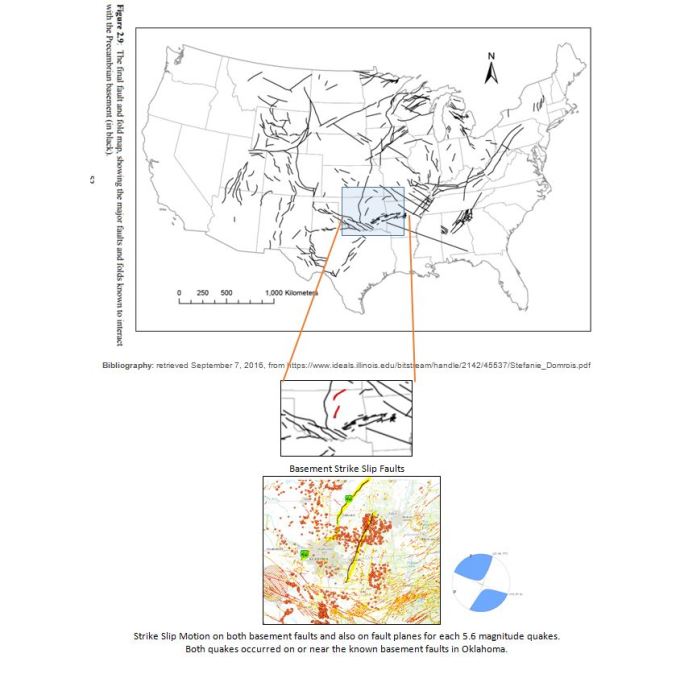
The quake (in green) at the top of the image is the Pawnee, OK, 5.8 magnitude quake of September 2016. The one in the center of the image is the 2011 5.6-magnitude quake near Shawnee, OK. Both show strike-slip motion in moment tensor solutions, USGS.gov.
Oklahoma has had two significant quakes (over 5.0 magnitude) since 2011. The earthquake in 2011 was 5.6 and located on a NE/SW trending strike-slip fault in the Precambrian basement rocks. The other occurred in September 2016 and was upgraded to a 5.8 magnitude. This quake was located on an NE/SW trending strike-slip fault in the Precambrian basement rocks.
Animation of strike-slip fault movement – Strike-slip fault IRIS EPO, 2010
Basement Strike-Slip Faults
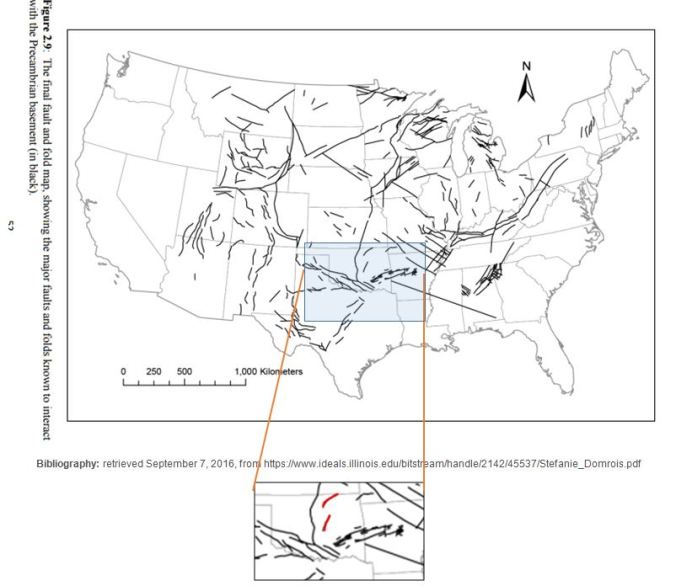
According to the USGS moment tensor solutions for both significant OK quakes, each fault plane associated with the earthquakes exhibited strike-slip motion, and both quakes occurred on or near the pre-existing strike-slip basement faults, highlighted in red below and shown in Figure 2.9. 2013, Domrois, S.L.
Summary
In my opinion, there is no conclusive evidence to support that the fracking process, in and of itself, has caused an increase in significant earthquakes in Oklahoma. We live on a dynamic planet, where the rocks beneath our feet constantly adjust to compensate for global/tectonic, regional, and local changing stress fields. Many variables are involved in the build-up and release of stresses at the surface or in the subsurface. Some stresses are human-induced, from climate change to mining economic resources (groundwater, oil, gas…), and some are a natural result of internal and external processes of planet dynamics.
The fact that both of these significant quakes were not near injection wells, but were, in fact, on pre-existing basement faults, seems to support the hypothesis that these larger quakes (5.0 and greater) are the result of tectonic adjustments in the Precambrian basement rocks. Whether or not the process of disposing of waste fluids in injection wells is contributing to the onset of these larger quakes is not supported directly. There is room for argument that human overprinting is affecting local stress fields and, in turn, influencing the regional stress fields. Existing faults may be re-activated, especially near clusters of injection well sites.
Geoscientists with greater access to specific subsurface data and computer modeling software will have to let us all know the answer to the question of fracking’s direct influence. From my limited perspective, there is not enough evidence to conclusively blame the process of fracking on the occurrence of significant seismic events.
Online Citations:
Domrois, S. L., (2013). The MIDCONTINENT EXPOSED: Precambrian basement topography, and fault-and fold zones, within the cratonic platform of the United States of America, Masters Thesis, University of Illinois at Urbana-Champaign, Retrieved from https://www.ideals.illinois.edu/bitstream/handle/2142/45537/Stefanie_Domrois.pdf
Guccione, M.J., (1993), Geologic History of Arkansas Through Time and Space,
Retrieved from http://www.geology.ar.gov/pdf/Geologic%20History%20of%20Arkansas%20Through%20Time%20and%20Space%20Color%20Copy.pdf
Earthquake Hazards Program. (2016). Retrieved from http://earthquake.usgs.gov/earthquakes/eventpage/us10006jxs#executive.
Phillips, C.D.,(2016). Oklahoma quake analysis, GIS online resources, Retrieved from https://sciencegranny.maps.arcgis.com/home/item.html?id=59ae60d3b46b481fae0750553a86e59
MarathonOilCorp. (2012). Animation of Hydraulic Fracturing (fracking), Retrieved from https://youtu.be/VY34PQUiwOQ
Water and Environmental Services, (2016) Cypress Energy Partners, Tulsa Inspection Resources, Retreived from https://cypressenergy.com/our-industries/water-and-environmental-services/
EPA, US Environmental Protection Agency. (2016), Natural Gas Extraction – Hydraulic Fracturing, Retrieved from https://www.epa.gov/hydraulicfracturing
IRIS EPO, (2010), IRIS.edu, Retrieved from Strike-slip fault http://www.iris.edu/hq/inclass/search#type=1
 Sciencegranny
Hey, Dianne, this is Dom. Suggest that you define overprinting early in the piece. Also, is there duplication or omission in citations in body of text and bibliography? I prefer text, but can be persuaded that both methods are helpful. Great blog!
Over printing refers to when tectonic events overlap in the subsurface. See Guccione’s pub for dynamics. Also, human over printing refers to the effects from humans, meaning our influence which is over printing on that of nature. Thanks Dom!
Hey Dom, I made that change. I also wasn’t sure about the citations for online within an online article. I just wanted to make sure that I was not plagiarizing any material.